

Overview
Our research group probes the interactions and properties of neutrinos using state-of-the art high-purity germanium semiconductor detectors. Our searches for neutrinoless double-beta decay can potentially illuminate the cause of the abundance of matter over anti-matter in our universe, and point to new physics at energy scales in excess of what is accessible by the largest of particle accelerators. Our measurements of Coherent Elastic Neutrino-Nucleus Scattering (CEvNS) have opened an entirely new channel for probing the standard model of particle physics. Our work has impacts spanning several fields, including nuclear physics, particle physics, astrophysics, and cosmology. The areas of neutrino physics where we focus our efforts provide opportunities for graduate and undergraduate students to gain experience in low-background radiation detection techniques including: operation of a variety of radiation detectors (semiconductor, inorganic/organic scintillators, liquid noble gasses); Monte Carlo simulation methods; data analysis and statistical interpretation; data acquisition systems and software; and vacuum and cryogenic technologies.
Neutrinoless Double-Beta Decay (0νββ)
The search for the as-yet-unobserved, ultra-rare form of nuclear decay known as neutrinoless double-beta decay (0νββ) is at present the only practical probe of whether neutrinos are Majorana particles, i.e. their own antiparticles. Majorana neutrinos would motivate an explanation for why neutrino masses are so small compared to the other elementary particles that make up our Universe, and shed light on the origin of the matter we observe in our Universe in the present day.
Matthew Green and the NCSU group have participated in the design, construction, and analysis of the Majorana Demonstrator, and its successor, LEGEND-200, while preparing for construction of the tonne-scale 0νββ experiment, LEGEND-1000.
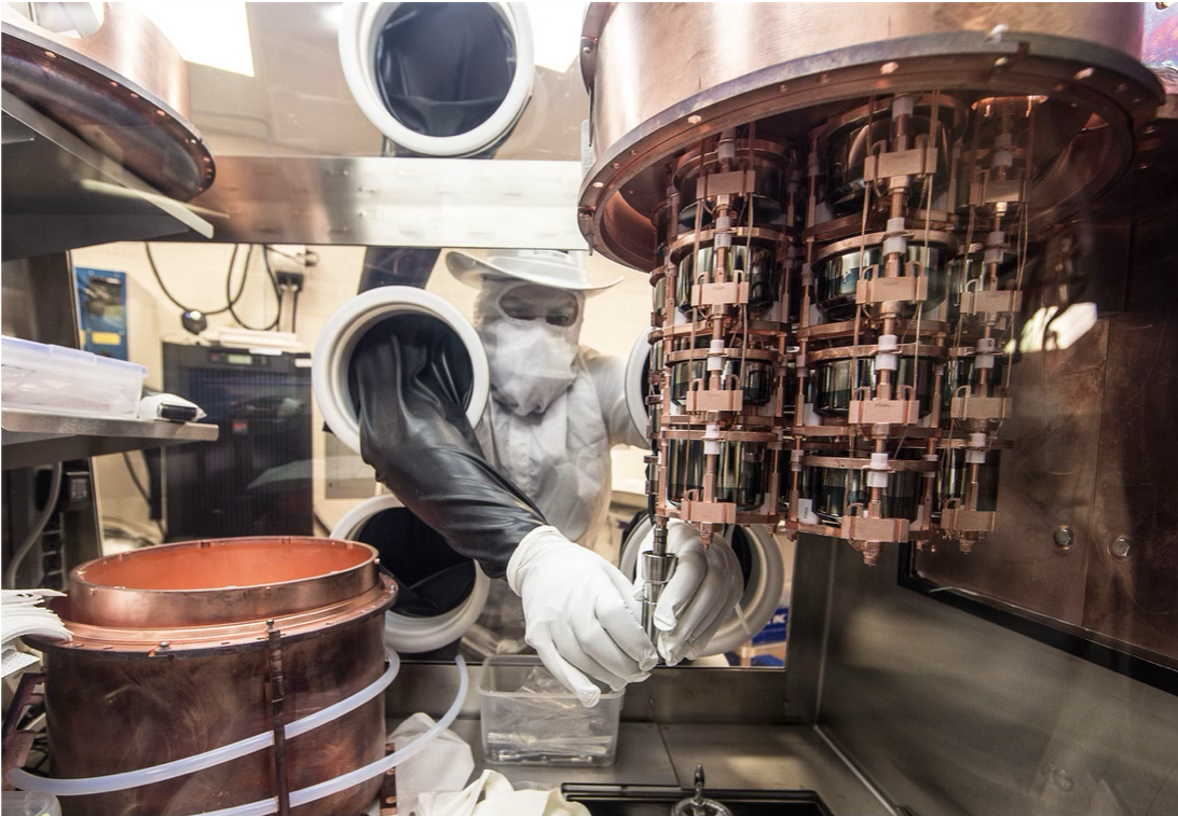
Matthew Green installing germanium detector strings into the Majorana Demonstrator neutrinoless double-beta decay experiment.
Majorana Demonstrator
The MAJORANA DEMONSTRATOR, was an experiment searching for 0νββ in 30 kg of P-Type Point Contact (PPC) germanium detectors enriched in the candidate isotope 76Ge, built and operated at the Sanford Underground Research Facility in Lead, SD. Notable outcomes from the Demonstrator’s now nearly-completed science mission include:
- Best demonstrated energy resolution of any 0νββ experiment to date, and measured background rate at Qββ surpassed only by GERDA and LEGEND-200;
- Setting of competitive limits on 0νββ in Ge-76;
- Setting world-leading limits on violation of the Pauli Exclusion Principle and charge nonconservation;
- Constraining the half-life of the decay of 180mTa; and
- Completing searches for solar axions and exotic dark matter candidates.
The LEGEND Collaboration was formed to advance germanium-based 0νββ searches to the tonne-scale, by drawing upon the best technologies developed for the Majorana Demonstrator and the GERDA experiment in a phased experimental effort aimed to extend 0νββ discovery half-life sensitivities to 10^28 years. This sensitivity, roughly 100x what has been realized to date, allows for coverage of the range of effective 0νββ neutrino masses allowed by the inverted neutrino mass ordering. LEGEND’s phased approach comprises the following:
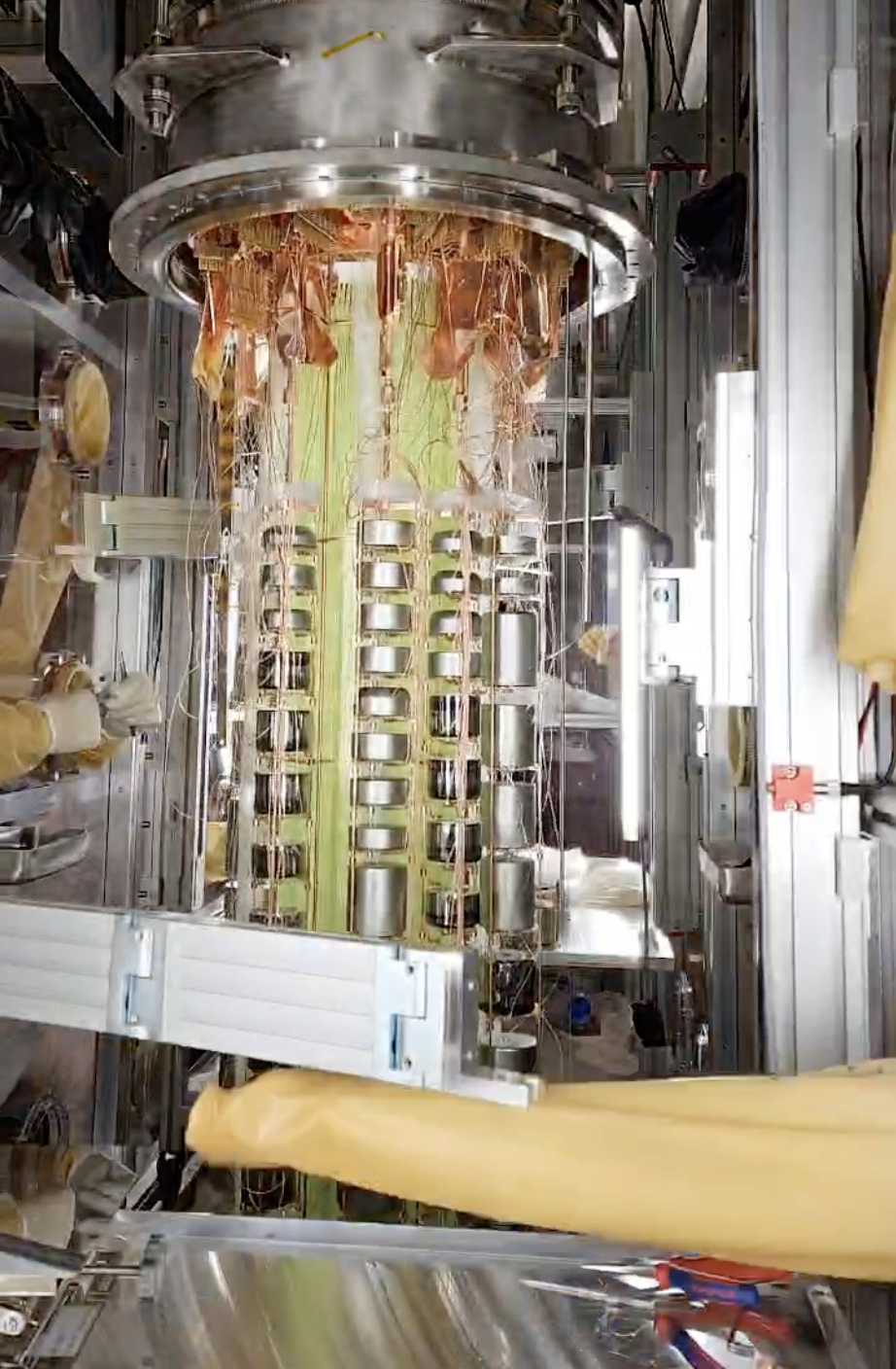
The LEGEND-200 neutrinoless double-beta decay experiment under construction at the Gran Sasso National Laboratory, near L’Aquila. Italy.
LEGEND-200
A 200 kg detector array deployed in GERDA’s existing cryostat and shielding infrastructure at LNGS, with projected discovery sensitivity to 10^27 years in 5 years of operation.

Conceptual design of the LEGEND-1000 neutrinoless double-beta decay experiment.
LEGEND-1000
A 1000-kg detector array to be deployed in a newly constructed cryostat at LNGS, with projected discovery sensitivity to 10^28 years in 10 years of operation. LEGEND-1000 has been selected as the preferred 0νββ tonne-scale technology by a 2019 portfolio review hosted by the DOE and NSF, and is in preparation for a DOE CD1 review scheduled for the Fall of 2025.
Our research group simulates, analyzes, and makes projections of expected backgrounds in LEGEND-200 and LEGEND-1000. Since the founding of the LEGEND Collaboration we have developed many of the tools used to date to accomplish these goals and organized the efforts of the simulations and background modeling working group.
We are supported in our LEGEND research by awards from NSF Office of Nuclear Physics, the DOE Office of Nuclear Physics (through an NCSU TUNL umbrella grant), and Matthew Green’s Joint Faculty Appointment with ORNL.
Coherent Elastic Neutrino-Nucleus Scattering (CEνNS)
The COHERENT Collaboration aims to use state-of-the-art low-threshold radiation detectors to develop Coherent Elastic Neutrino-Nucleus Scattering (CEvNS) as a new channel for probing neutrino parameters, the Weak interaction, and nuclear structure. CEvNS is a standard-model neutral current scattering process in which a low momentum transfer elastic scattering has a strong cross-section enhancement due to the coherent addition of neutrino-nucleon scattering amplitudes spanning the entire nucleus. Despite the large cross section for this process compared to other neutrino interactions, the daunting technical challenges inherent in its detection prevented its observation until COHERENT successfully measured it in a CsI target, as reported in Science in 2017. Since that first measurement on CsI, COHERENT has performed the first-ever measurements of CEvNS on 2 additional nuclear targets: argon and germanium. These measurements have been significantly leveraged by the phenomenology community, who have made use of the complementary nature of our multi-target approach and additional new CEvNS measurements from the community to constrain nuclear radii, weak nuclear charge, and non-standard neutrino interactions (e.g. DOI: 10.1007/JHEP01(2021)116, 10.48550/arXiv.2506.13555).
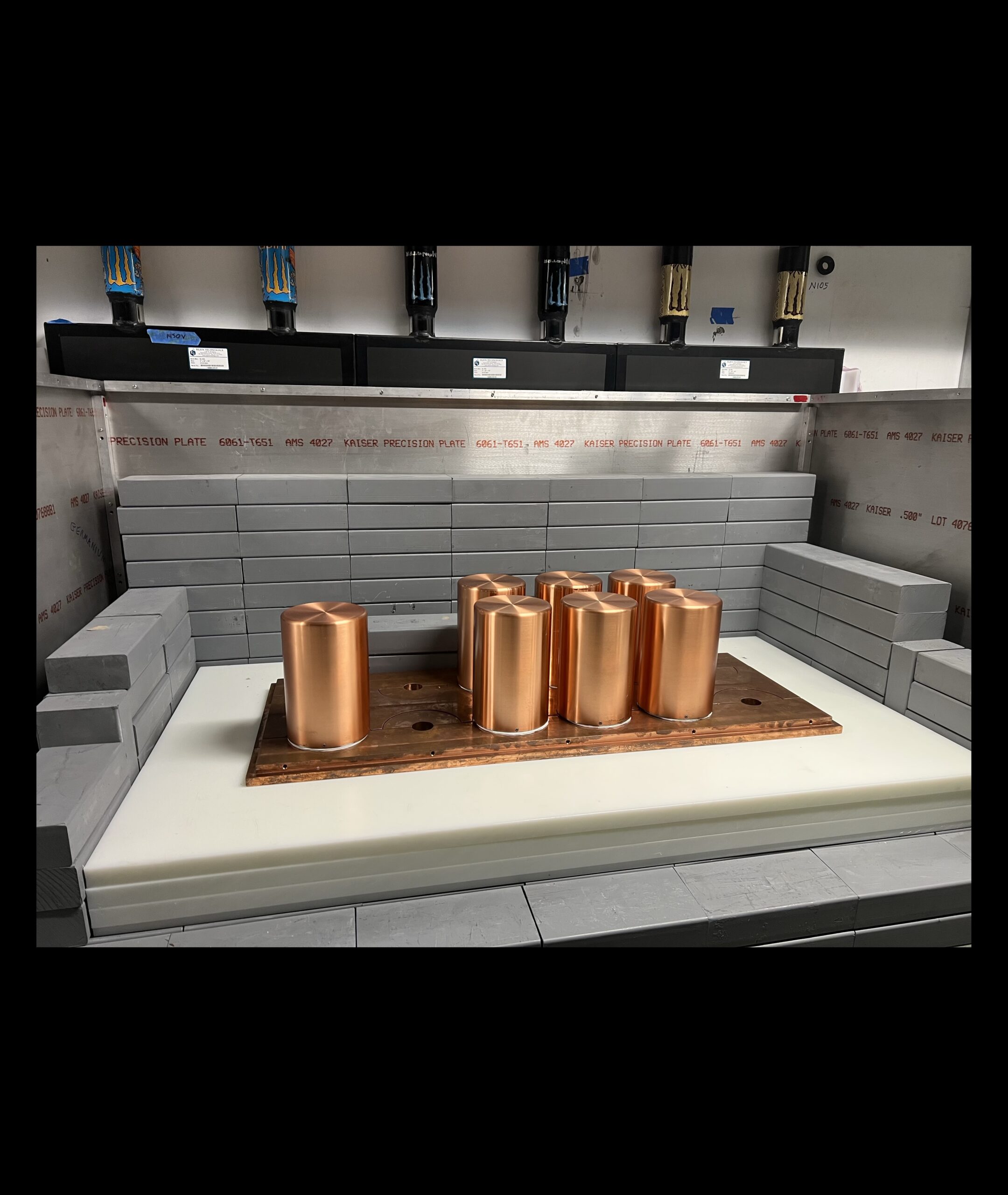
The Ge-mini CEvNS detector array system (7 of 8 germanium detectors shown).
Matthew Green leads COHERENT’s germanium-based efforts, making use of improvements in germanium detector technology that have lowered energy thresholds and improved energy resolution while increasing detector mass. The COHERENT germanium working group designed, built, and has operated Ge-mini, an array of 8 state-of-the-art germanium detectors at the SNS (supported by NSF MRI award PY-1920001). In a 2-month period in 2023, Ge-mini performed the world’s first unambiguous measurement of CEvNS in germanium with 3.9σ significance (as reported in PRL, and detailed in NCSU graduate student James Browning’s PhD dissertation). Subsequently the SNS has completed its “Proton Power Upgrade” project, and after a long outage has returned to normal operation. We are continuing to acquire data with Ge-mini, and our updating our measurements of CEvNS as we do so.
We are supported by an award from the Department of Energy, Office of Science, Office of High-Energy Physics to study CEvNS with germanium.